Join our monthly newsletter where you will find interview advice, Prospect HQ updates, and more!
Share



“The only thing of real importance that leaders do is to create and manage culture.”
— Edgar Schein
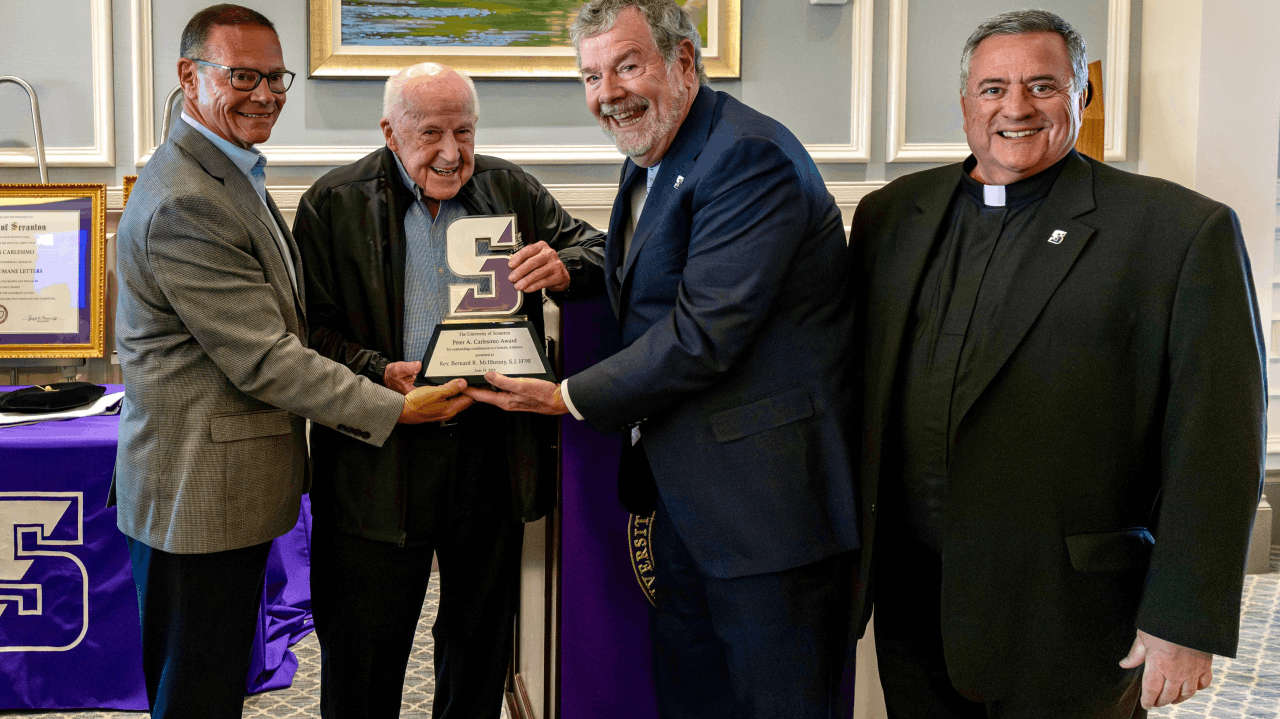
Last week I had a seat at the University of Scranton’s annual Pete Carlesimo Golf Tournament & Award Dinner, an evening named for my dad, who spent nearly three decades as Scranton’s athletic director and head coach. My oldest brother, P.J., received an honorary doctorate from Scranton’s president, Rev. Joseph Marina, S.J., and I had the privilege of sitting beside Rev. McIlhenny, S.J. (“Father Mac”), who was accepting the lifetime achievement award that carries my dad’s name. At 100 years old, Father Mac is a true Jesuit servant-leader and an institution unto himself. P.J. built a remarkable life in sports and is one of the best human beings I know, which didn’t stop me from observing that he was an interesting candidate for this one, given the preternatural volume of JUG (Justice Under God, aka Jesuit detention) he must have logged under Father Mac at Scranton Prep. Father Mac’s response was perfect: “No comment.”
I could fill this entire column with Father Mac’s stories, like the night in the 1960s when he first wandered into our kitchen to find my dad cooking a late-night pasta feast for half the neighborhood after a CYO game. But the thread running through the evening wasn’t nostalgia. It was culture, the thing my dad spent his life building, and the thing Scranton Athletics has quietly turned into a genuine case study.
During the ceremony, Athletic Director Dave Martin pointed to the Landmark Conference Presidents’ Trophy displayed behind him, awarded each year to the league’s top overall program, and Scranton’s for the third time in seven years. The Royals won nine conference championships this year, a school record and the most any institution has won in a single season in Landmark history. The crown jewel was the women’s basketball team, which went 32-1 and reached the Division III national championship game for the first time since 1985. Along the way, the Lady Royals beat Pitt 69-63 on the Panthers’ home floor. I have been told this was the only time a Division III program has ever taken down a Power 4 opponent.
To appreciate these results, you have to know where Scranton started. In 2014, the athletic department sat tied for 215th in the Learfield Directors’ Cup, the annual ranking of the best overall collegiate programs by division. This year, Scranton finished 54th out of more than 400 eligible schools. That leap reflects over a decade of the Royal Way’s compounding intention.
And “intention” is exactly the word. When I congratulated Dave on the department’s success, his reply told me everything: “I am most proud of the intentionality of our culture and the incredible student-athletes we graduate into the world year after year.” I believe that culture and leadership are never about perfection. They’re about intention, and about holding yourself accountable to the authentic pursuit of a vision.
It started in 2014, when Scranton Athletics and Bobby Davis, Scranton’s Vice President for University Advancement, partnered with alum and culture consultant Matt Davidson to design what they call "The Royal Way." It is a distinctly Jesuit culture of excellence that constellates around a clear set of values. Mission, vision and values are meaningless if they’re only hollow words on a website or a marketing brochure. But when leaders live them and embed them into the fabric of their organization, those values become an operating system and a north star.
When a team of us from Prospect HQ presented to Scranton’s Student-Athlete Advisory Committee this year, we met a room full of purposeful, deeply impressive young men and women, a reminder of why student-athletes have gone on to become high-impact employees, culture-carriers and servant-leaders in the workplace for generations.
I notice it because I was raised inside it. My dad, Pete, played football at Fordham alongside Vince Lombardi and the legendary Seven Blocks of Granite during the program’s halcyon years as a national power, and then gave nearly forty years to the Jesuits as an athletic director and head coach at Fordham and Scranton. He used to joke that “the Jesuits took a vow of poverty and made guys like me keep it.” I’m the youngest of his ten children, all Fordham graduates, with two Fordham law degrees and six Jesuit prep diplomas thrown in for good measure.
The Jesuits have been woven into my family for as long as I can remember. Founded by St. Ignatius and his companions in 1540, the order has always captivated and inspired me. If I were explaining the Jesuits to George Lucas or a more secular audience, I would describe them as the Jedi Knights of Christianity: erudite educators, philosophers and theologians who teach critical thinking, discernment, self-awareness and, above all, service to others. They taught me to question everything, even church dogma, or whether my dad’s late-night pasta was cooked perfectly al dente. My relationship with organized religion has wavered over the years; my gratitude to the Jesuits never has.
If you ever doubt that culture is the ultimate driver of performance for any organization, just spend twelve years watching Scranton Athletics. They are leading with culture and Jesuit values, and they are doing it the Royal Way. It’s the kind of culture my father spent his life building, and seeing it carried forward in his name was the real gift of the evening.
“We are not human beings having a spiritual experience. We are spiritual beings having a human experience.”
— Pierre Teilhard de Chardin, S.J.
.png)
.png)