.webp)
Join our monthly newsletter where you will find interview advice, Prospect HQ updates, and more!
Share



Senior Year Job Search Timeline for Student-Athletes: What to Do and When
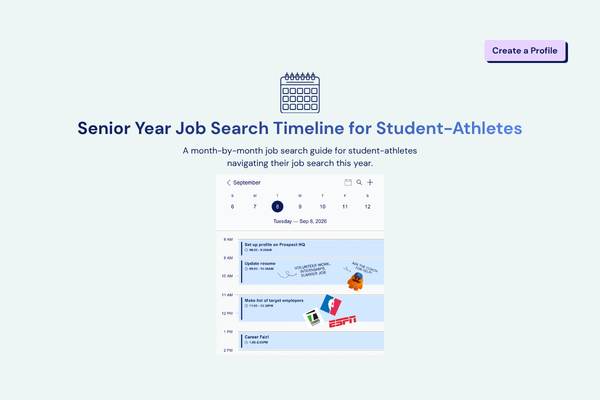
You’ve done a version of this schedule before. Preseason, lifts at 6 a.m., film on Tuesdays, travel on weekends, checking the conference standings telling you exactly where you rank. Senior year adds a second season on top of that one, and this one does not post a schedule on the locker room wall. A senior year job search timeline is the closest thing to it: a month-by-month plan that runs alongside your sport so you leave campus with an offer instead of a blank calendar and a lot of questions.
Here is why the timing matters more than most seniors realize. The job market for your class is actually moving in your favor. Employers expect to increase hiring of new college graduates by 5.6% for the Class of 2026, with large companies planning to grow entry-level hiring by 8.7%, according to the National Association of Colleges and Employers (NACE). What you may not realize is all those entry-level roles don’t open up all at once. They open on a calendar, and the athletes who scout that calendar early tend to be the ones holding offers by spring.
At Prospect HQ, we built our platform around this exact handoff from sport to career, because we kept watching talented athletes wait until the season ended to start looking, then scramble against peers who had been recruiting since September. We want to help by giving you a playbook so to speak about what to do each month of your senior year, plus the part that never makes it into a career-center handout: what to leave behind for the teammates coming up behind you.
Why should your job search follow your athletic season?
Because your season already dictates when you have time, energy, and access, and a smart plan works with that rhythm instead of fighting it.
Trying to run a full job search during your competitive peak is how good candidates burn out and miss deadlines. But treating the offseason and the shoulder months as dead time is how you fall behind. The fix is to match the intensity of your search to where you are in your season. Heavy prep work in the quiet months, lighter maintenance during your heaviest travel, and a real push when your sport winds down and your schedule opens back up.
This is the same logic behind our spring job search calendar for student-athletes, which many spring-sport and graduating athletes use to close out the year. The senior year version starts earlier, in the fall, because a lot of full-time recruiting front-loads into the first part of the semester - and trust us, you don’t want to learn that in November.
The senior year job search timeline, month by month

Use the calendar below as your baseline, then shift it to fit your sport. A fall athlete and a spring athlete will flip some of these blocks, and that’s expected / recommended. The order of operations holds either way: build the foundation, get visible, apply with intent, then convert.
August and September: build the foundation before it gets loud
Preseason, energy high. The first few weeks back are the calmest your calendar will be all year, so spend them on the work that everything else depends on. Update your résumé with the experience you already have, whether that is volunteer work, an internship, or a summer job, and translate your athletic career into language a hiring manager actually reads. "Started 38 games while carrying 15 credit hours" says more about your reliability than the word "hardworking" ever will. Our guide on putting athletic experience on a résumé walks through phrasing that survives applicant tracking software. Set your target list of employers while you are at it, and get to the first career fairs of the year.
This is also the month to get on Prospect HQ so employers can find you while you are still in preseason. Download the Prospect HQ: Athlete to Career app, build your profile, and finish the Personal Insights questionnaire, which takes about ten minutes from your phone and is the piece that actually makes you matchable. When your skills, attributes, and culture fit live in one place, the right roles start coming to you instead of the other way around.
One more way to get ahead early: look into a fall internship for class credit. A lot of programs run on part-time hours that flex around practice, so you get real experience on your résumé without giving up your season. It counts toward your degree and it gives you something concrete to talk about in spring interviews. If you want help fitting one around your schedule, our guide on finding a student-athlete internship around your season covers the how.
October and November: apply in-season without losing your season
In-season, schedule packed. Full-time recruiting heats up in the fall, and so does yours. The trap here is intensity. You cannot run a 20-application-per-week search during your competitive peak without one of the two seasons suffering. So keep it consistent instead of heavy. A few strong applications a week, steady attention to postings from employers on your target list, and a standing habit of connecting with new people on Prospect HQ and LinkedIn, one coffee chat or one alumni message at a time.
Lean on your network in these months, because a warm introduction costs you far less time than a cold application. Coaches, alumni who played your sport, boosters, and academic advisors form a web most athletes underuse. Former athletes tend to answer current ones, because they remember exactly how this felt.
December: convert, refine, and actually rest
Break and finals. December is short and strange, wedged between finals and the holidays, but it does two jobs. First, if you did a fall internship or had one over the previous summer, this is conversion season. That matters more than it used to: the intern-to-full-time conversion rate hit 63.1% for 2024-25, the highest in five years, and 88.3% of interns who got an offer accepted it. If you have a foot in the door somewhere, this is the month to push it open with a direct conversation about a return offer.
Second, take the feedback you gathered in the fall and rework your materials. Rejections and quiet applications tell you something. Adjust and move on. Then take a beat and rest. You have earned it, and most of the hiring world shuts down over the holidays anyway. You cannot recruit well in January running on empty.
January and February: the real push
Offseason or new term. For most seniors this is the heaviest recruiting stretch of the year, and often the lightest athletic one. Spring career fairs open, employers restart hiring after the new fiscal year, and your schedule finally has room. Go wide and go deliberate at the same time. Ten thoughtful applications to companies whose culture actually fits you will beat a hundred generic ones.
This is the month to sharpen your interview game. If you have never had to explain what running a locker room or anchoring a relay taught you, practice it out loud before a recruiter asks. The traits are already there. Employers rank teamwork, communication, and leadership at the top of what they want in new grads, and a student-athlete's ordinary week is built on all three. Harvard Business School research found that being a team player is a repeatable predictor of business success. Your job in the interview is translation.
If you are still mapping which roles fit you, our breakdown of the best careers for former athletes is a useful place to start, though we would not let it fence you in.
March and April: interview, compare, decide
Spring stretch. Now the applications turn into conversations, and the conversations turn into offers. Move fast on follow-ups, and treat every interview as two-way. You are evaluating them as much as they are evaluating you.
When offers come in, resist the urge to sort them by salary alone. Weigh the whole picture: the culture, the kind of work you are actually interested in, the room to grow at the company, and the total comp package rather than the base number by itself. The athletes who stay and grow are usually the ones who picked a fit that held up on all of those, not just pay. Research bears the payoff out: former college athletes tend to see faster salary and seniority growth in their first five years than non-athlete peers, and one analysis found they out-earn non-athletes by roughly $220,000 over a career. You are choosing where to start a long run, not just a first paycheck.
May and June: accept, prepare, and leave the locker room better than you found it
Season and school ending. Sign the offer. Prep for onboarding the way you would prep for a season opener, with a little homework and a lot of readiness. And then do the thing that separates a good senior from a great one: hand off what you learned.
You spent four years with a team beside you, and it is easy to forget how much that carried you until you are the one holding the door for the people behind you. Tell the juniors when full-time recruiting really starts. Show a sophomore how you wrote the résumé line you were proud of. Introduce a teammate to the alum who helped you. None of it takes long, and all of it is the kind of thing you will wish someone had done for you.
How early is too early to start a senior year job search?
There is almost no such thing as too early, but there is definitely too late. Starting in the fall of your senior year is standard. Starting in your junior year, especially through a summer internship, is even better, because that is where a lot of full-time offers quietly get made before senior year even begins. Internships are worth chasing on their own timeline, and our guide on finding a student-athlete internship around your season covers how to fit one in without missing a season.
What if your season and recruiting season collide head-on?
They will, and that is normal. Try not to do everything at once. It is to protect your two or three highest-value job-search activities and let the rest wait. During your competitive peak, those are usually keeping your profile visible, maintaining your network with a message or two a week, and hitting real application deadlines. Everything else, the deep research and the wide applying, moves to your lighter weeks.
The skills that make this possible are the same ones your sport built. If you want to see them laid out plainly, our piece on the career readiness skills student-athletes already have is a good mirror to hold up to your own year.
Your last season is your first season, too

Senior year asks you to compete in two arenas at once. Build early, stay consistent when your sport gets loud, push hard when it quiets down, and choose an offer for the right reasons. Do that, and you walk across the graduation stage with a season still in you, just in a new arena.
You do not have to run this schedule alone, and now you can run most of it from your phone. Prospect HQ was built to connect current and former student-athletes with employers who value skills, attributes, and culture fit in one place, so you get matched for the right reasons. Download the Prospect HQ app, finish your profile in about ten minutes, and let the fit start finding you while you close out the season in front of you.
Frequently asked questions about student-athlete job search
When should student-athletes start their senior year job search?
Start in the fall of your senior year, or earlier if you can. A lot of full-time hiring front-loads into the first semester, and many offers trace back to a junior-year summer internship. If it is already spring, start now anyway. The market hires into summer, and a focused search still works.
How do you job hunt during your competitive season?
Match the search to your schedule. During your season's peak, protect two or three high-value activities: keep your profile visible, maintain your network, and hit real deadlines. Save deep research and apply during your lighter weeks.
Do internships really turn into full-time jobs for student-athletes?
Often, yes. The intern-to-full-time conversion rate reached 63.1% for 2024-25, the highest in five years, and most interns who receive an offer accept it. If you did a fall or summer internship, treat the months after it as conversion season and ask directly about a return offer.
How do I put my sport on my résumé when I apply?
Translate accomplishments into outcomes. Instead of listing years played, show what the role required and produced, like balancing training hours with a full course load or leading a team through a season. Name the transferable skill once, then prove it with a specific example.
Is the job market good for the college class of 2026?
It is improving. Employers expect to increase new-graduate hiring by 5.6% for the Class of 2026, with large employers planning an 8.7% jump, per NACE. The roles open on a recruiting calendar, though, so timing your search well is how you reach them.
.jpg)
.jpg)